jueves, 28 de julio de 2011

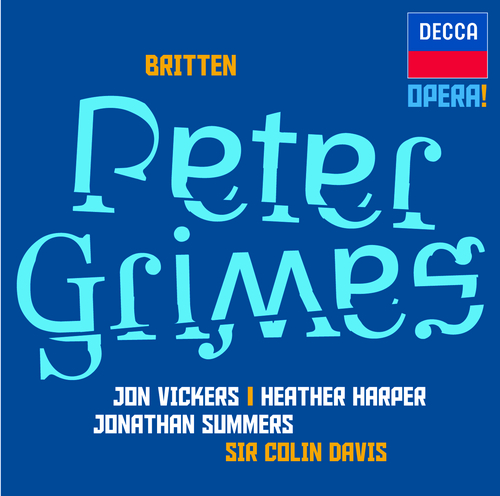
Benjamin Britten - Peter Grimes


Benjamin Britten (1913-1976)
Peter Grimes, Op. 33 - Opera in a Prologue and Three Acts (1945)

Peter Grimes - Jon Vickers
Ellen Orford - Heather Harper
Captain Balstrode - Jonathan Summers
Auntie - Elizabeth Bainbridge
First Niece - Teresa Cahill
Second Niece - Anne Pashley
Bob Boles - John Dobson
Swallow - Forbes Robinson
Mrs. Sedley - Patricia Payne
Rev. Horace Adams - John Lanigan
Ned Keene - Thomas Allen
Hobson - Richard van Allan

Chorus and Orchestra of The Royal Opera House, Covent Garden
Sir Colin Davis, conductor

Peter Grimes is Britten's most famous opera and arguably his greatest achievement. Although he wrote the role of Grimes for his life-long partner, Peter Pears, it is widely acknowledged that perhaps the greatest interpretation of the role came from Jon Vickers in this recording.
The music is adequately eerie and atmospheric, describing the otherworldly feel of the coastal Borough, which is based on Britten's Aldeburgh, and it continually rustles with the restlessness of the Borough as gossip and hearsay become more and more important in determining whether Grimes is innocent or not. A beautiful piece of work, and in my opinion, one of the greatest operas ever written.

More about the plot:

Download:

jueves, 21 de julio de 2011

I am afraid for myself

Nikolai Kapustin - Piano Music


Nikolai Kapustin (b. 1937)
Piano Music
Marc-André Hamelin, piano

Kapustin is a Russian composer and pianist who writes really great piano music with a lot of jazz influence. The incredibly technically demanding and rhythmic pieces are a perfect fit for the incredible abilities of Hamelin, and this release is just marvelous.

sábado, 2 de julio de 2011

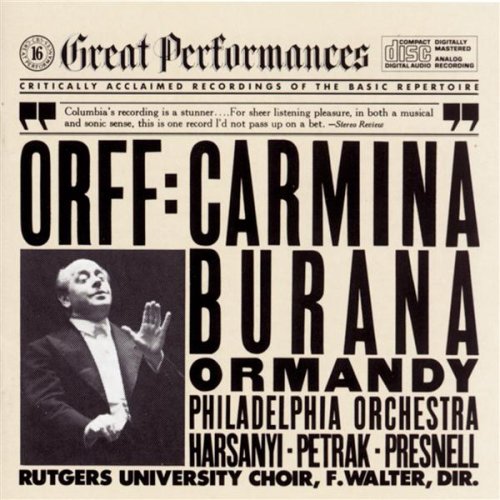
Carl Orff - Carmina Burana


Carl Orff (1895-1982)
Carmina Burana (1936)
Philadelphia Orchestra
Rutgers University Choir
Janice Harsanyi, Rudolf Petrak, Harve Presnell
Eugene Ormandy, conductor

From Wikipedia:
Carmina Burana is a scenic cantata composed by Carl Orff in 1935 and 1936. It is based on 24 of the poems found in the medieval collection Carmina Burana. Its full Latin title is Carmina Burana: Cantiones profanæ cantoribus et choris cantandæ comitantibus instrumentis atque imaginibus magicis ("Songs of Beuern: Secular songs for singers and choruses to be sung together with instruments and magic images.") Carmina Burana is part of Trionfi, the musical triptych that also includes the cantata Catulli Carmina and Trionfo di Afrodite.
Orff first encountered the text in John Addington Symond's 1884 publication Wine, Women and Song, which included English translations of 46 poems from the collection. Michel Hofmann, a young law student and Latin and Greek enthusiast, assisted Orff in the selection and organization of 24 of these poems into a libretto, mostly in Latin verse, with a small amount of Middle High German and Old Provençal. The selection covers
a wide range of topics, as familiar in the 13th century as they are in the 21st century: the fickleness of fortune and wealth, the ephemeral nature of life, the joy of the return of Spring, and the pleasures and perils of drinking, gluttony, gambling and lust.

This is a really great work, one of the cornerstones of 20th Century choral music. I'm actually singing this tomorrow, and I have been half-jokingly ragging on Orff's tendency to repeat everything a lot of times and over-simplify harmonically. However, it's obvious that it's the intention of the work to achieve an archaic yet oddly out-of-this-world atmosphere, and he does just that with his mixture of homophonic, almost modal writing, along with Stravinskian orchestration and rhythmic construction. I can't think of another work that I can compare to this, and that is always a good thing. If you don't know this, I suggest you give it a shot, it's always mentioned as a good "introductory" piece to classical music, it's really accessible.


domingo, 19 de junio de 2011

Schnittke / Pärt - Voices of Nature


Alfred Schnittke (1934-1998)
Concerto for Choir (1984-85)
Voices of Nature, for ten women's voices and vibraphone (1972)

Arvo Pärt (b. 1935)
Doppo la Vittoria (Piccola Cantata) (1996-98)
Bogoroditse Djevo (1990)
I am the true vine (1996)

Swedish Radio Choir
Tonu Kaljuste

Amazing choral music from Russian composer Alfred Schnittke, who is best known for his 9 symphonies and his series of neo-baroque Concerti Grossi. The Concerto for Choir is one of the most incredible a capella choral pieces I've ever heard, and the Swedish Radio Choir does a wonderful job with it.
Also included, little known choral settings from the 90's by Estonian composer Arvo Pärt, which also offer a lot of surprises and beautiful moments.
This disc is truly one of the best I have to offer, so git on it!

sábado, 18 de junio de 2011

Steve Reich - Different Trains/Electric Counterpoint/Three Movements


Steve Reich (b. 1936)
Different Trains / Electric Counterpoint / Three Movements
Kronos Quartet
Pat Metheny, electric guitar
London Symphony Orchestra
Michael Tilson Thomas

Different Trains was composed by Reich for the Kronos Quartet, and it is a reflection on how different his life could've turned out if he had only been born in Europe. Being Jewish, he sees now that instead of traveling from SF to NY as a child, he would've been in a very different train had he been born in Europe. The work makes use of a technique that has come to be a trademark of Reich, which is to notate musically pre-recorded spoken excerpts. The excerpts come from interviews with Jewish people and with people Reich knew, who talk about subjects from the trains themselves, to Europe and American before and after WWII. A thoroughly gripping work, and its intense rhythmic drive is pure Reich, especially foretelling the rhythmic intensity of later works like Double Sextet and 2x5.
Electric Counterpoint is a work for electric guitar and tape that Reich wrote for jazz guitarist Pat Metheny. Building dense layers of polyphonic textures in the tape, the live guitarist and the listener becomes enveloped in an amazing soundscape, which goes from pulsating harmonies, very much a la Music for 18 Musicians, in the first movement, to a funky, bass-driven counterpoint texture in the third movement.
The disc doesn't originally include the Three Movements for Orchestra, but I've included them, as the corresponding disc on the Steve Reich 1965-1995 box set does, in a great interpretation by the LSO with Michael Tilson Thomas conducting.

viernes, 17 de junio de 2011

Franz Schubert - Lieder (21 CDs)


Franz Schubert (1797-1828)
Lieder
Dietrich Fischer-Dieskau
Gerald Moore

This set is one of the best things I have. Schubert's Lieder are amongst the most beautiful music I've ever heard, and it saddens me that the only people who seem to pay proper attention to it are singers and accompanists.. You'll find some of the best Schubert compositions in this set.
DFD is on top form, singing everything perfectly and expressively, bringing out all the nuances in the music. Gerald Moore, probably the greatest accompanist to ever have lived, plays beautifully, showing how much you can make a piano sing, and how many different levels you can bring out to a piece of music.

I'll be posting the 21 discs on this same post, so stay tuned.

Download: